
Rosa Emilia Cordero and Laura Quiñones present The Black Puerto Rican "Colección" Project

Rosa Emilia Cordero Cruz, History PhD student at Rutgers University, and Laura Quiñones Navarro, Instituto de Cultura Puertorriqueña, present their Black Puerto Rican Colección Project: A Guide to Afro-Caribbean History Through the Objects and Artifacts Found in the Instituto de Cultura Puertorriqueña’s Fine Arts Collection.
On September 22, 2023, Cruz's interdisciplinary group, the Caribbean Working Group at Rutgers, organized a hybrid archival tour of the Fine Arts Program of the Instituto de Cultura Puertorriqueña (ICP)’s National Collection. The event was conducted with the guidance of the collection’s director, María Del Mar Caragol Rivera, and the Afro-Puerto Rican ICP Auxiliary Registrar, Laura Quiñones. This wonderful presentation displayed artifacts, artworks, and sources illuminating Puerto Rico’s slaveholding, slave-trafficking, and anti-black past while simultaneously explaining the richness, depth, and cultural importance of Black Puerto Rican Culture and History in the U.S. territory.
Together, Cruz and Rivera discussed how these visual sources are more than materials displayed around museums or hidden away for preservation. They reveal enslaved and post-slavery Black Puerto Ricans' brutal lives in the archipelago while also serving as reminders of the cultural worlds they built. The event aimed to expose those in attendance to the existing research possibilities in Puerto Rico, and it accomplished its purpose while simultaneously encouraging Director Caragol Rivera, Laura Quiñones, and Rosa Emilia Cordero to brainstorm how they might continue their collaborative relationship. This collaboration was eventually made possible because of Rutgers’s Digital Humanities Initiative’s Seed Grant.
Thanks to the sponsorship provided by Rutgers DHI, Cruz and Quiñones, with the support of Director Caragol Rivera, created a virtual guide (publication pending) of two of the ICP’s National Collection’s many sub-collections: the Colección de Artes Populares (Collection of Popular Arts) and the Colección de Muebles y Objetos (Collection of Furniture and Objects). Quiñones, as Auxiliary Registrar of this archive, had observed over her many years in the ICP how visitors would often neglect to consult these collections and instead would spend their research time focusing on more obvious divisions of the archive, such as its collections on paintings and sculptures. This would result in the accidental omission of Black Puerto Rican knowledge productions and histories from their studies since many artifacts, musical instruments, and slaveholding technologies were stored under the two aforementioned collections. Her worry over the visibility of these objects inspired her and Cruz to create a project that exclusively highlights the sources found under these categories. Consequently, with the eventual publication of this digital guide, the authors hope to encourage contributions to Black Puerto Rican studies, facilitate scholars of Black Puerto Rico’s research findings, and provide Puerto Rican afrodescendants with a more accessible digital archive of objects relating to their own familial and community histories.
Paul Boxer and Franklin Moreno publish new article on Honduras-US policies and youth
Rutgers Newark professor Paul Boxer and Temple University professor Franklin Moreno publish their article "Advancing a transnational ecological systems framework for research on exposure to violence".
Scholars have underscored the need to integrate research from more diverse contexts and local realities across national borders to inform global perspectives on developmental science. As multination developmental studies have increased, one area requiring further attention is the ways in which countries that wield greater power influence the local realities of youth in other countries. The domain of public safety, insecurity, and violence for youth evinces important issues related to local conditions shaped by foreign government policy interventions. In this paper we draw from multinational studies, research on exposure to community violence, Bronfenbrenner’s ecological model of human development, and policy between the United States and Central America. Utilizing Central America as a case study, our analysis examines how transnational governmental policies of the US are distal processes that have real-life impacts on youth’s proximal experiences with violence and safety in Honduras. We propose a transnational ecological systems framework for advancing developmental theory and research on violence to expand from a within country application of ecological systems to a between country model to account for these transnational, distal processes. We conclude with theoretical and research implications and applications with the aim of advancing a more comprehensive and accurate understanding of context-specific and general developmental processes and outcomes.
To read the paper, click here.
Professor Antonio Hernandez-Matos presents at the Fashion/Media: Power and Possibility Conference in Dallas, Texas

Professor Antonio Hernandez-Matos, an instructor in the Department of Latino and Caribbean Studies, recently presented his paper "To Be or Not to Be Modern: Fashion, Gender, and Ambiguity Towards Modernity in Early 20th Century Puerto Rico” at the Fashion/Media: Power and Possibility Conference in Dallas, Texas on February 28-March 1, 2025. He was part of a panel titled "Structures and Barriers of Fashion".
 Panelists of Structures and Barriers of Fashion, Fashion and Media, Power and Possibility Conference, SMU, Dallas, Texas, on March 1, 2025. (Photo, Chloe Casdorph)
Puerto Rican historiography still argues that Puerto Ricans resisted the modernity represented by the U.S. from the beginning of the change in colonial power. However, this paper argues that at the start of the 20th century, Puerto Ricans had an ambiguous and tense relationship with a “colonial modernity” they both desired and feared. To support this argument, this paper examines two representations that coexisted in Puerto Rican periodicals: the first is the “masculinized” modern woman, portrayed as cold-blooded, egocentric, narcissistic, greedy, opportunistic, and calculating. The paper analyzes what critics perceived as the symbols of Puerto Rican women's masculinization: the fading “art of crying” and the bobbed hair that crowned the head of so many chicas modernas. Critics considered Puerto Rican modern women to be in the process of masculinization. They denounced fashion and modernity as the culprits, arguing that they were encouraging Puerto Rican modern women to dispose of any trace of sentimentality.
The other representation analyzed is the “naked” chica moderna, depicted as lost in worldly pleasures and always being on the verge of corruption and damnation. The paper examines the representations of the gradual “stripping” of modern women’s bodies by fashion, focusing on the symbolism of three pieces of clothing: the tube dress, the short skirt, and the bathing suit. Critics and commentators correlated fashion’s unveiling of women’s bodies with a public display of eroticism on their part, which represented a problem for the keepers of social morality, secular or religious. The paper shows how these two opposite representations of Puerto Rican women are the best examples of Puerto Rican's tense, ambivalent, and ambiguous relationship with the unforeseen consequences of colonial modernity.
Haiti 1964: Killing the Elites--Talk by Jean Philippe Belleau
Rutgers Masters in Social Work Students Dive into Social Work in Puerto Rico
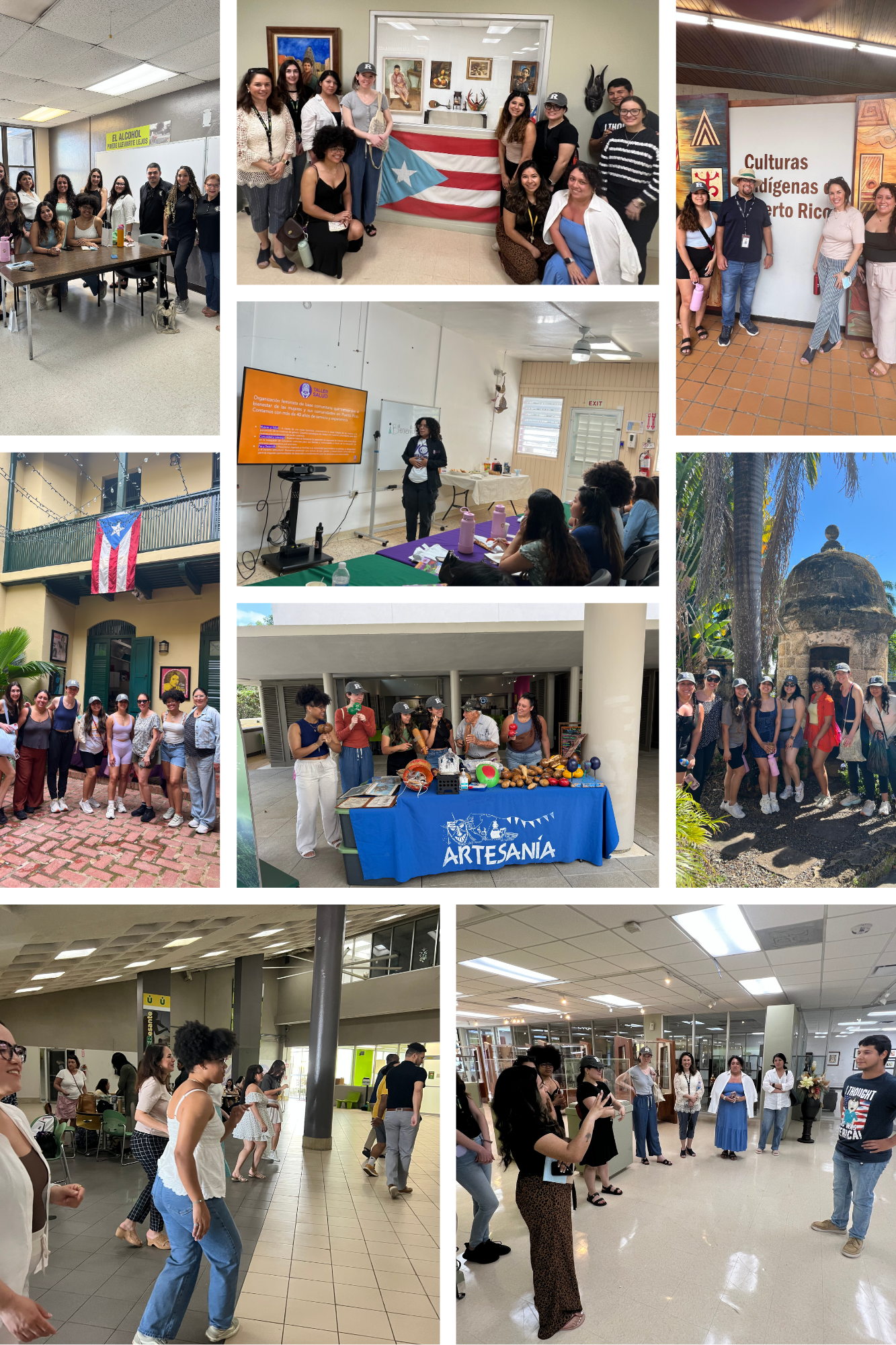
Over spring break, eight Masters in Social Work (MSW) students, guided by Dr. Elsa Candelario, traveled to Puerto Rico for a 10-day immersive study abroad experience. They engaged with human service organizations, connected with Puerto Rican social work students and professionals, attended the NASW-PR conference, and took part in rich cultural experiences across the island.
The trip proved to be deeply meaningful—described by several students as one of the most impactful moments of their MSW journey.
- Interview with Dr. Américo Mendoza Mori on the Quechua Language
- Rutgers faculty, PhD Students, and PhD Candidates present at 2025 MACLAS Conference
- Jian Ren Successfully Defends His Dissertation and gets position at the Stanford University Hoover History Lab
- Congratulations to the Spring 2025 CLAS/RAICCS Grant Recipients