
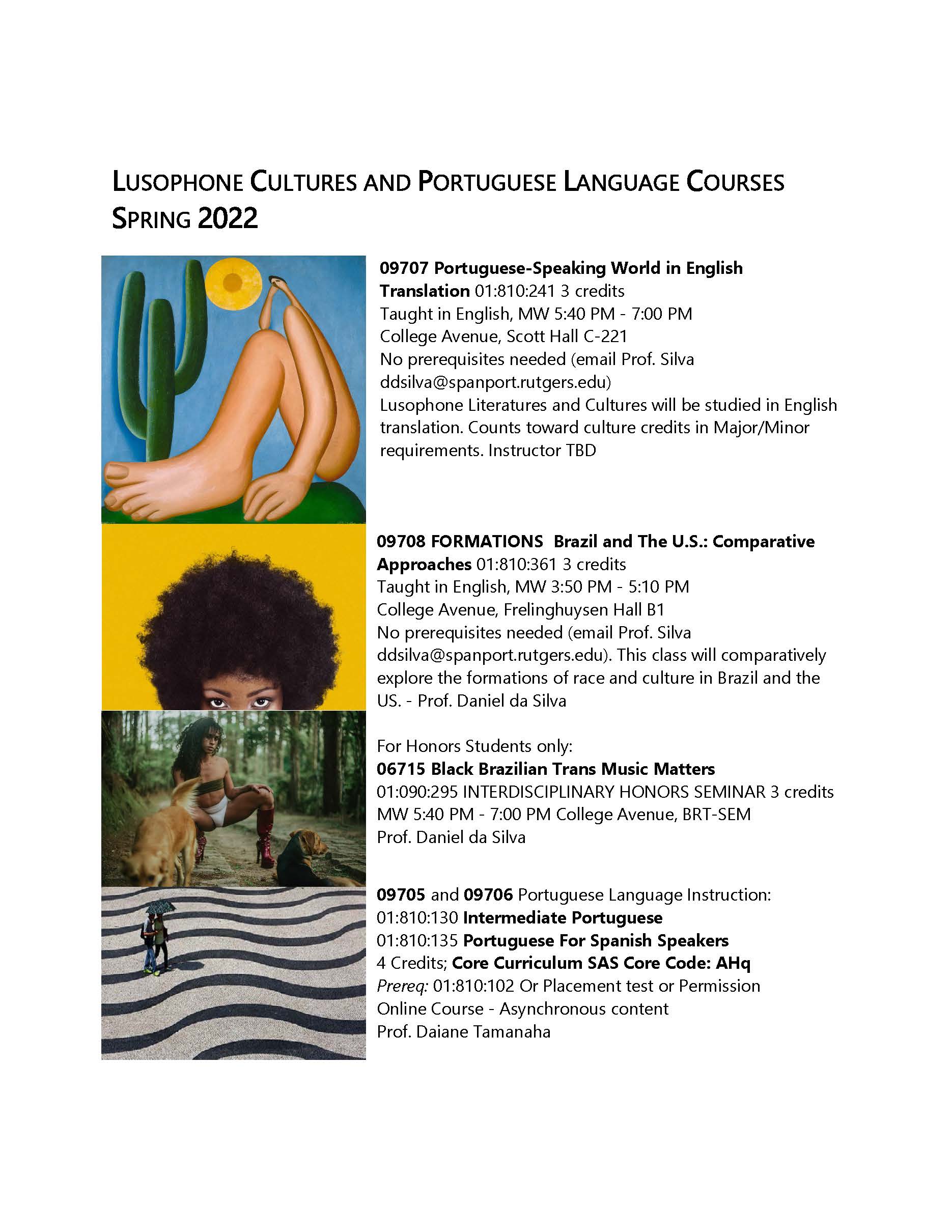
Spring 2022 Lusophone Courses
New CLAS Faculty Affiliates
New CLAS affiliated faculty:
Daniel Da Silva
ASSOCIATE PROFESSOR
Department: Department of Spanish and Portuguese
Gender, sexuality, race, performance and popular music in the Portuguese-speaking world
https://span-port.rutgers.edu/people/faculty/faculty-directory/814-daniel-da-silva
Maria Gloria Dominguez Bello
PROFESSOR
Department of Biochemistry and Microbiology; SEBS
Microbiome development from birth, functions for the host, microbial transmission, microbiota, strategies for restoration, Westernization and environmental microbes and human exposures, urban studies and microbial ecology
https://dbm.rutgers.edu/personnel/maria-gloria-dominguez-bello.html
Priscilla Ferreira
Assistant Professor
Department of Geography/Department of Latino and Caribbean Studies
Afro-Latinx Geographies, Black solidarity economies, urban geography, Afro-Latina feminisms, and decolonial methodologies and pedagogical praxis
https://geography.rutgers.edu/people/faculty/918-ferreira-priscilla
Tamara Lee
ASSISTANT PROFESSOR, LABOR STUDIES AND EMPLOYMENT RELATIONS
Rutgers School of Management and Labor Relations
Political and economic reform in Cuba U.S. labor and employment law
https://smlr.rutgers.edu/faculty-staff/tamara-lee
Pilar Rau
ASSISTANT TEACHING PROFESSOR
Department: Anthropology
Cultural anthropology; visual arts; media studies; sociolinguistics; religion; aesthetics, visual anthropology, and economic anthropology; Latin America; Peru;
https://www.anthro.rutgers.edu/fac/629-pilar-rau
Robert Ramos
NSTRUCTOR
Latino and Caribbean Studies
Music of the Caribbean; New York Latin Music; Caribbean and Latino Studies; Percussion
Jorge Reina Schement
Distinguished Professor
Department: School of Communication and Information
Inequality History Networks, Digital Inequality, Public Policymaking, Social Justice, Mexico, Tejas
https://comminfo.rutgers.edu/schement-jorge-reina
Kimberly Da Costa Holton
ASSOCIATE PROFESSOR
Department of Spanish and Portuguese Studies
Music, migration and politics; 20th century Portuguese and Brazilian literature, performance theory, urban festivity, urban ethnography, migration and memory studies, oral history, theories of globalism, nation, diaspora and space.
https://sasn.rutgers.edu/about-us/faculty-staff/kimberly-dacosta-holton
Isadora Grevan
ASSISTANT PROFESSOR
Department: Spanish and Portuguese Studies
Brazilian literature, Brazilian theater, performance studies, dramaturgy, Latin American theater, Latin American studies, Portuguese world, Lusophone African literature, Comparative Literature, gender studies, cinema
https://sasn.rutgers.edu/about-us/faculty-staff/isadora-grevan
Melissa Valle
ASSISTANT PROFESSOR
Sociology and Anthropology
Race & ethnicity ;Urban & spatial sociology; Cultural sociology Economic sociology; The African/Black Diaspora (with a focus on Afrolatinidad in the Americas); Ethnographic and visual method
https://sasn.rutgers.edu/about-us/faculty-staff/melissa-m-valle-phd
Carla Giaudrone
ASSOCIATE PROFESSOR
FASC - Foreign Languages
Post-colonial theory, Latin American Modernismo, feminist theory, and gender studiesPersonal\
https://foreignlanguages.camden.rutgers.edu/faculty/carla-giaudrone/
Juan Gonzalez
RICHARD D. HEFFNER PROFESSOR OF COMMUNICATIONS AND PUBLIC POLICY AND PROFESSOR OF PROFESSIONAL PRACTICE, JOURNALISM AND MEDIA STUDIES
Journalism & Media Studies, School of Communication and Information
Journalism; mass media history; federal mass communications policy; history of Latinos in the United States; Puerto Rico-U.S. relations; immigration, race and labor relations; the role of dissident movements in social change
https://comminfo.rutgers.edu/gonzalez-juan-d
Rafael Logroño
TEACHING INSTRUCTOR
Journalism & Media Studies, School of Communication and Information
Identity, media, and social justice, with an emphasis on Latinx communities
https://comminfo.rutgers.edu/logrono-rafael
Kevon Rhiney
ASSISTANT PROFESSOR
Geography
global change, rural agrarian livelihoods, biopolitics, political ecology, environmental justice, postcolonial thought, Caribbean region
https://geography.rutgers.edu/people/faculty/471-rhiney-kevon
Hyacinth Miller
INSTRUCTOR AND ASSISTANT TEACHING PROFESSOR
Department: Department of Latino and Caribbean Studies, New Brunswick; African American and African Studies, Newark; Political Science, Newark
Caribbean Studies, Caribbean immigrants in the Diaspora, immigrant women and women of color in elected leadership, immigrant political incorporation and comparative politics
https://sasn.rutgers.edu/about-us/faculty-staff/hyacinth-miller
Nicole Burrowes
ASSISTANT PROFESSOR
Department: Department of History
African Diaspora; Modern Caribbean and African American History
https://history.rutgers.edu/people/faculty/details/56-professors/1212-burrowes-nicole
CLAS Announces Post-Doctoral Position
Rutgers Center for Latin American Studies
The Center for Latin American Studies (CLAS) of the School of Arts and Sciences at Rutgers University, New Brunswick, invites applications for a non-renewable two-year Postdoctoral Associate position in Latin American Studies. We seek applicants with strong multi-regional training in the fields of Anthropology, Geography, History, Politics, or Sociology, with work on migration, race, gender, or urban studies. Specialists on Central America or Mexico whose work engages state policies, migration, borders and mobilities, inequality, violence, social and political movements, environmental themes and indigenous, Afro-descendant communities, are especially encouraged to apply.
The Postdoctoral Associate will receive mentorship from the Director and from the Center’s affiliated faculty and support for their conference, research, and publications work, including digital exhibits. The Associate must maintain an agenda of research, teaching, and participation in CLAS. Teaching obligations are three courses yearly and will include an introductory survey and a senior seminar. The Associate is expected to participate in conferences, workshops, and seminars sponsored by CLAS and help organize events in their field. The Associate may also participate in the many rich forums provided by the larger SAS and Rutgers communities including the Rutgers Center for Historical Analysis, the Latino Studies Research Initiative, the Center for Cultural Analysis, and many others.
For further details: Rutgers University Employment Opportunities | Post Doctoral Associate
For details on the CLAS.
New Course: The History of Puerto Rico
The History of Puerto Rico
(LCS 01:595:371/History 01:508:371)
Instructor: Aldo Lauria Santiago
This course will provide students an advanced introduction to the history of Puerto Rico in Caribbean and American contexts. The study of the post-conquest history of Puerto Rico history covers over five centuries. Four hundred years under Spanish rule and over 100 under US rule. Because of this persistent colonial history Puerto Rico is often presented as an exceptional place with a history unlike any other. Puerto Rico presents some unique characteristics because of its hybridity-a self-identified nation that is thoroughly integrated into the United States; a mostly Spanish-speaking country that considers itself part of Latin America and the Caribbean; a diasporic nation with millions of island-born people living on the US mainland.
Weekly Themes:
Week 1: Requirements and Goals; Geography and Demographics
Week 2: Conquests, Settlement and Marginalization in Caribbean and Imperial Context, 16th-17th Centuries
Week 3: The 18th Century: Cows, Enslaved, Plebeians and Forts:
Week 4: Reconquests, Slavery, Peasants, and Commercial Agriculture, 1812-1868
Week 5: Spanish Colonial Rule and the Landlord Economy, 1868-1898
Week 6: Liberation by Invasion: 1898: The Transition to US Rule in Caribbean Context
Week 7: Elite Politics of Negotiation, Adjustment and Accumulation--Colonial Rule 1898-1920s
Week 8: Working Class Life and Politics, 1898-1930s
Week 9: The Depression and Crisis: Elite Crisis, Labor Revolt and Nationalist Insurgency, 1929-1939
Week 10: New Deal, War and Reform Restructure the Colony, 1939-1952
Week 11: Economic Transformation and the Public Sector, 1948-1980
Week 12: Emigration and Diasporic Culture
Week 13: Manufacturing, Construction and Services: Crisis, Recovery and Crisis, 1975-2017
Week 14: The Never Ending Debate: Autonomy and Colonial Rule
Week 15: Transitions from Crisis, 2018+
New Course on Central American and Mexico--Spring 2022
CLAS Post-Doc Jennifer Trowbridge will be teaching a new course for CLAS in the Spring 2022 Semester
“Introduction to Mexico and Central America”
This course will provide students with an advanced introduction to Mexico and Central America, including migrations from these countries to the United States. Taking a multidisciplinary approach, this course draws on history and anthropology – particularly medical anthropology – to examine the political conditions that shape social movements and social lives in Mexico and Central America. We will begin with a brief history of the region during Spanish colonialism, and of revolutionary movements that were met with authoritarian, US-backed state violence in Guatemala, El Salvador, Nicaragua, and Mexico (Chiapas) in the late 20th century. We will then turn to contemporary medical anthropology and other ethnographies as a lens through which to explore intersections of race/ethnicity, class, gender and queerness among Mexicans and Central Americans in the region and transnationally. The course will address migrations from Central America and Mexico to the United States, with particular attention to the effects of the COVID-19 pandemic. We will examine the Mexico-US “border crisis” as a humanitarian crisis for migrants with severe political, psychological, and medical consequences. Through the course, students will become familiar with social life, social movements, and northward migration among Mexicans and Central Americans, learning from the perspectives of people from those regions.
Keywords: Mexico, Central America, Medical Anthropology, History, migration, social movements, gender, LGBTQ
For more details see our course offerings page.