Professors Berg and Sebastian publish co-authored articles.
Professors Ulla Berg (Latino & Caribbean Studies/Anthropology) and Sebastian Kenneth Leon (Latino & Caribbean Studies/Criminal Justice) have just published to co-authored articles. Both are also co-authored with Sara Tosh.
"Migrant Detention and COVID-19: Pandemic Responses in Four New Jersey Detention Centers." Journal on Migration and Human Security.
April 5, 2021.
Joyce Lu presents at MACLAS conference
Rutgers Ph.D. Student (anthropology) Joyce Lu will present a paper at the MACLAS Conference this month.
From Columbus to Coronavirus: discourses of pandemic in post-genocide Guatemala
On July 29, 2021, protesters arrived to the Central Park of Quetzaltenango, Guatemala to protest the President and Attorney General’s dismissal of anti-corruption prosecutor, Juan Francisco Sandoval, as well as the delayed distribution of COVID-19 vaccines. Both pro-vaccine and anti-vaccine protesters rallied together against government corruption, carrying posters asking where the vaccines were, demanding resignations from the President, Attorney General, and Minister of Health, and promoting a plurinational Guatemala. Others depicted the face of democratically elected former President Jacobo Árbenz, who was overthrown in a 1954 CIA-backed coup that sparked four decades of civil war. In this paper, I situate narratives about COVID-19 within discourses about Guatemala’s history of civil war and colonialism. Despite limited state acknowledgement of the genocides of indigenous communities during the civil war, how do memories of war resurface in Guatemala’s current sociopolitical milieu? What insights do rumors and theories of COVID-19 origins and nefarious vaccines reveal about collective memories of annihilation and elimination in postwar, postcolonial Guatemala? I examined these questions through ethnographic methods of participant observation and unstructured interviews between June to August 2021 amongst residents of urban Quetzaltenango. Drawing from methods in narrative analysis, I find that stories about origins, spread, and management of the COVID-19 pandemic take on various discursive forms that include those of perpetrators vs. victims, duplicity, and Guatemala’s place in a global political economy. I also suggest that these different discursive forms have distinctive implications for how Quetzaltecans perceive possibilities of political participation and activism.
Yale RITM joins CLAS in the Puerto Rico Archival Collaboration
The Yale Center for the Study of Race, Indigeneity and Transnational Migration, directed by Professor Stephen Pitti, has decided to partner with the CLAS in supporting the work of organizing, facilitating and publishing the materials held by the Archivo General de Puerto Rico. The CSRITM will fund at least three of their graduate students for a month in the summer when they will dedicate half their time to the work of the Archivo, directed by Hilda Ayala. They will also fund at least one local student in contributing to this work.

The Collaboration began in September 2021 and involves the Coleccion Puertorriquena of the University of Puerto Rico Library, its Digital Collections held at the Coleccion Digital Puertorriqueña and the General Archive and National Library of the government's Instituto de Cultura Puertorriqueña.
For more information visit the Project Page.
Central America--History and Migration
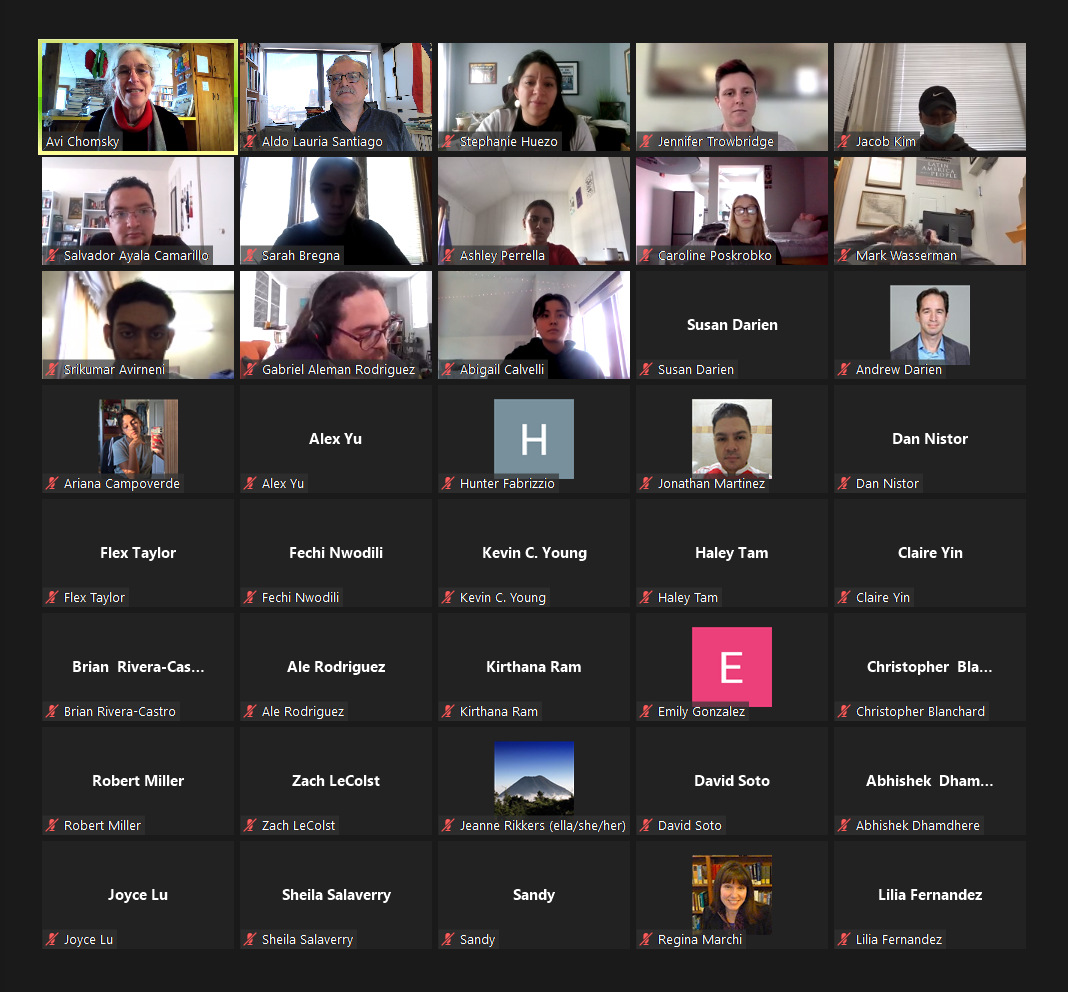 Over 45 undergraduate and graduate students and faculty--including guests from other universities--joined the CLAS for a talk by Professor Aviva Chomsky of Salem State University. Professor Chomsky presented her book on Central American migration. Her recent book with Beacon Press, analyzes the connections between failed reform and revolution in Central America, originating in the 1980s, are at the root of the continued poverty and the recent emigration crisis.
Professor Chomsky is an activist scholar who has published many books. Some are academic monographs. Man others are oriented towards affecting US policies on immigration, poverty and empire.
Her recent book focuses on Central American history and the more recent migration and refugee crisis on the US border with Mexico.
After reviewing the 20th century history of the Central America region in relation to US dominance and economic development priorities she discussed how the obstacles placed to democratization and economic development have resulted in the various migration surges streams from the region since the 1980s. She remined us of the wave of war refugees of the 1980s and early 1990s from Nicaragua, El Salvador and Guatemala. Honduras, did not experience an internal war but became a base for massive US military presence and militarization through irregular militias and the strengthening of local police and military training.
The book, published by Beacon Press, is organized into ten chapters and a conclusion:
CHAPTER 1
Invisibility and Forgetting
CHAPTER 2
Making the United States, Making Central America: Bananas, Coffee, Savages, and Bandits
CHAPTER 3
The Cold War, Ten Years of Spring, and the Cuban Revolution
PART II: REVOLUTION IN THE 1970 AND ’80S
CHAPTER 4
Guatemala: Reform, Revolution, and Genocide
CHAPTER 5
Nicaragua: “Luchamos contra el yanqui, enemigo de la humanidad”
CHAPTER 6
El Salvador: Si Nicaragua Venció, ¡El Salvador Vencerá!
CHAPTER 7
Honduras: Staging Ground for War and Reaganomics
CHAPTER 8
Central America Solidarity in the United States
PART III: KILLING HOPE
CHAPTER 9
Peace Treaties and Neoliberalism
CHAPTER 10
Migration
CONCLUSION
Trump’s Border War
u
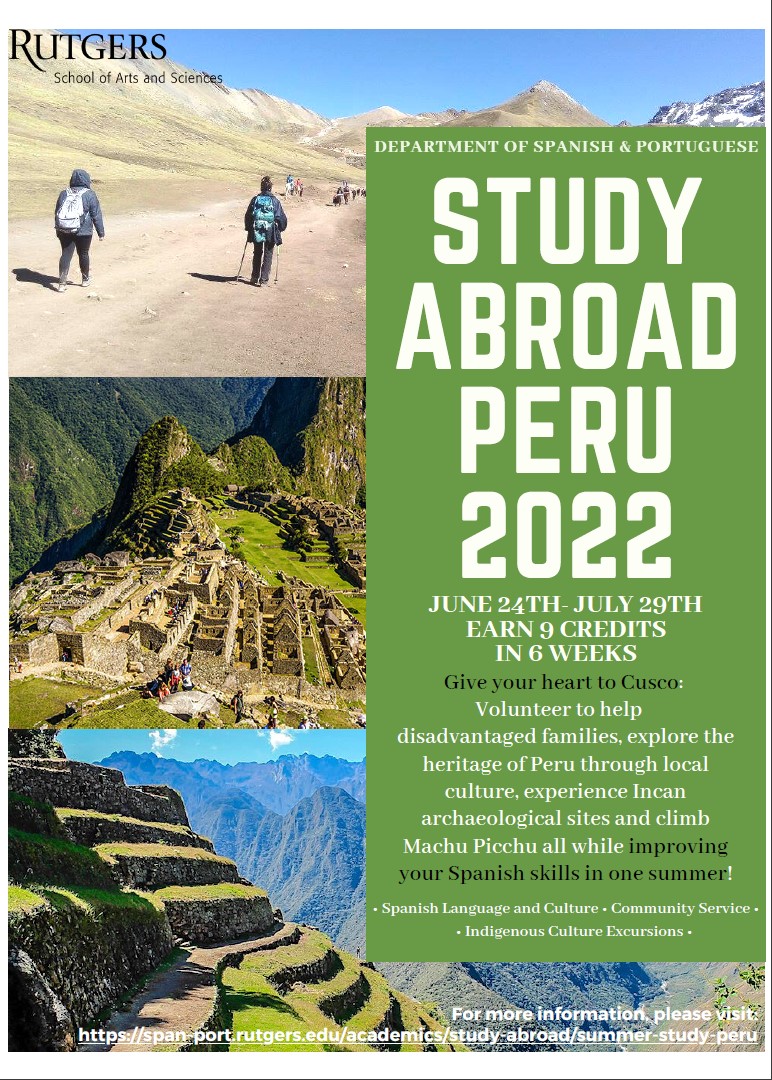
2022 Study Abroad in Peru!
DEPARTMENT OF SPANISH & PORTUGUESE
STUDY ABROAD PERU 2022
JUNE 24TH- JULY 29TH
EARN 9 CREDITS IN 6 WEEKS
After two years in Covid hiatus, Rutgers in Perú is returning from June 24th through July 29th. This program allows students to earn up to 9 Rutgers credits as they combine classwork with community service in Cusco, the heart of the ancient Incan Empire.
The 6-week program includes weekend visits to historical sites and traditional festivities, a free weekend for personal adventure, and 3 days on Lake Titikaka. We move from the traditional ways of Cusco to end our time with a visit to Lima, the modern capital city.
Give your heart to Cusco:
Volunteer to help disadvantaged families, explore the heritage of Peru through local culture, experience Incan archaeological sites and climb Machu Picchu all while improving your Spanish skills in one summer!
∙ Spanish Language and Culture ∙ Community Service ∙ Indigenous Culture Excursions
For more information, please visit:https://span-port.rutgers.edu/academics/study-abroad/summer-study-peru